I build AI tools for other teams.
At Rive, I was the only writer at a 40-person company. AI was how I covered the surface area.
I handled everything written: blog posts, case studies, product launches, sales collateral, internal comms, and UX copy. As a trained writer with over 15 years of experience, I used AI to extend my capacity without sacrificing quality.
Building AI tools for other teams
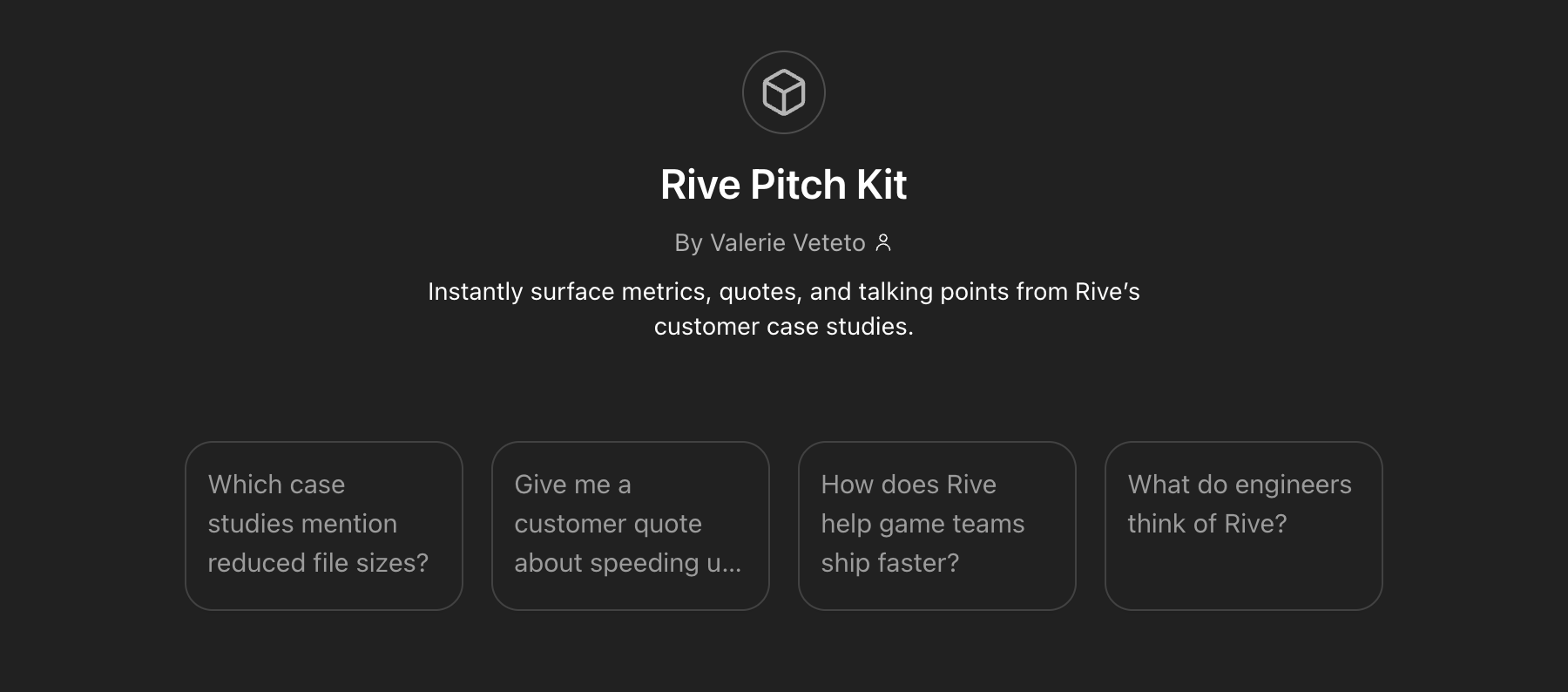
The most useful thing I built wasn’t for me. I created a custom GPT for the sales team, loaded with every case study, metric, and product proof point we had. Now they could surface what they needed in the middle of a pitch. It turned months of content work into something immediately queryable and freed me up to make more of it.
Using AI as an editorial partner
Without a writing team, I had no one to gut-check my or my contractors’ drafts. I started using ChatGPT to fill that gap. I’d drop interview transcripts in to surface the strongest quotes for case studies, and then ask it to grade finished drafts against a rubric I’d defined. It flagged where arguments were thin, where structure broke down, and where voice was dry. I treated its feedback like a junior editor’s.
Using AI for content strategy at scale
I fed our full content library into a model to audit for strategic gaps, such as which topics we’d over-indexed on and which questions our audience was asking that we’d never answered. What would have taken a week of manual analysis took me an afternoon. The output shaped our editorial calendar for the next quarter.